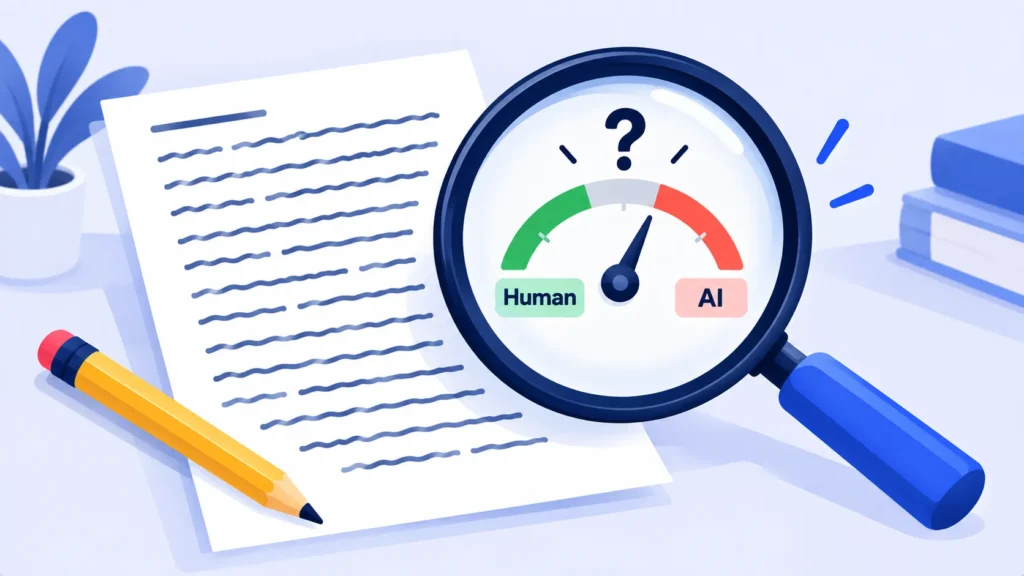
You spent all weekend writing an essay. Then your teacher says an AI detector flagged it as 40% AI. You didn’t use AI at all. Now what?
This happens more often than most people think. AI detectors can be useful, but they are not lie detectors. Here’s how they work, how accurate they really are, and what students and teachers should do with the results.
The Short Answer
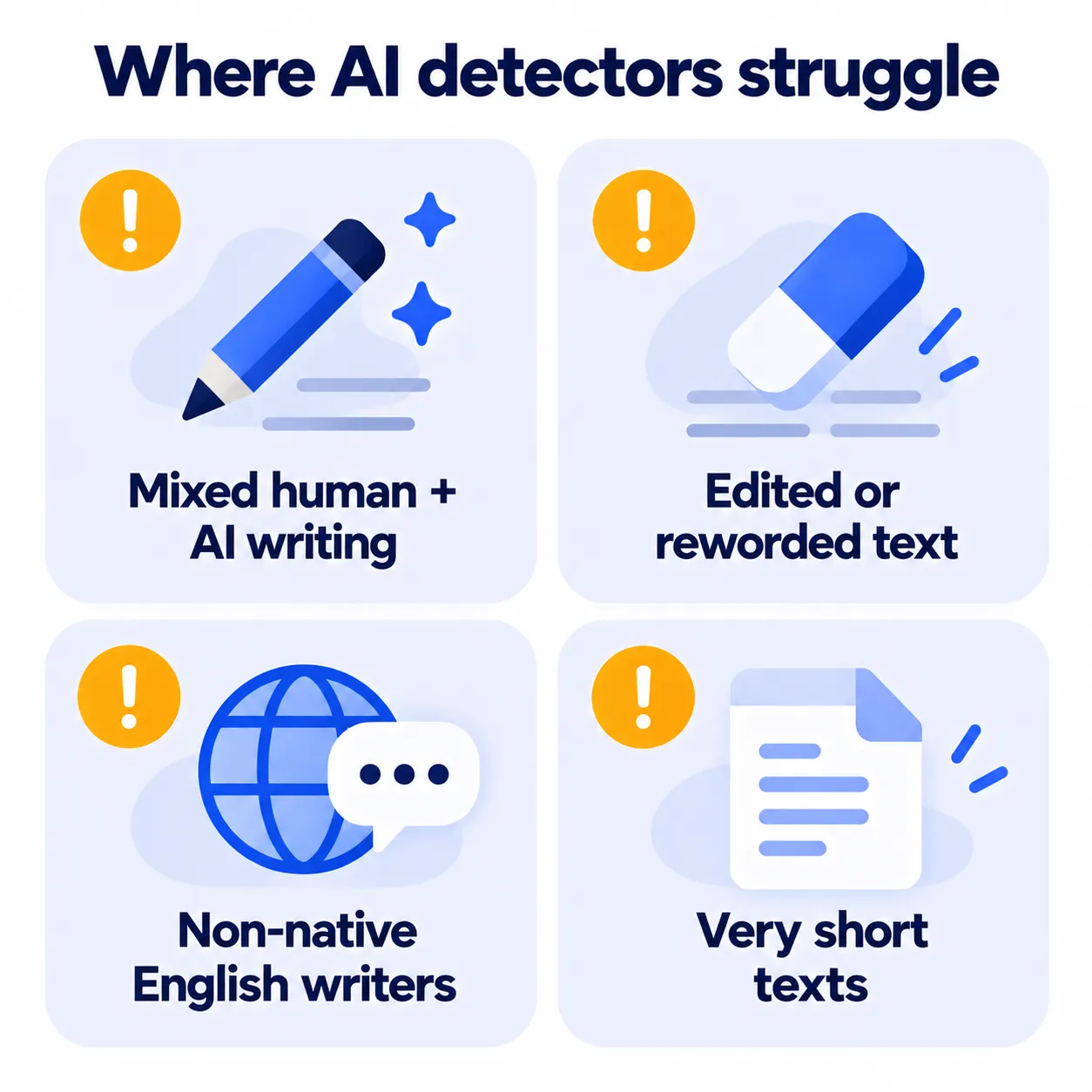
AI detectors work sometimes. They’re fairly good at catching long chunks of raw, unedited AI text. They’re much weaker at judging writing that mixes human and AI work, writing that has been edited, and writing by people whose first language isn’t English. No detector is accurate enough to prove, by itself, that someone cheated.
How AI Detectors Work
AI writing tools tend to choose the most predictable next word. Detectors look for that pattern. Text that is very smooth, evenly structured and predictable scores as “likely AI.” Text with more surprising word choices and uneven rhythm scores as “likely human.”
The problem is obvious once you see it: plenty of humans write in a clear, simple, predictable way. That’s often exactly what teachers ask for.
What the Research Says
- Accuracy varies widely. A 2023 study of 14 detection tools, including Turnitin and GPTZero, found all of them scored below 80% accuracy (Wikipedia summary of Weber-Wulff et al.).
- Non-native English writers get flagged far more. A Stanford-led study found seven detectors wrongly flagged essays by non-native English speakers as AI an average of 61.3% of the time (Wikipedia).
- Editing fools them. Research shows detection accuracy drops sharply once AI text is paraphrased or reworded (arXiv survey).
- Even small error rates add up. When Vanderbilt University turned off Turnitin’s AI detector in 2023, it noted that a 1% false-positive rate across about 75,000 papers a year could mean roughly 750 students wrongly flagged (GradPilot).
Turnitin itself reports a false-positive rate under 1% for documents with more than 20% AI content, but it also says false positives happen and that its report shouldn’t be used alone to penalize a student (Yomu).
Note: These details come from the company’s own announcements and have not been independently verified by Next DigiTech.
If You’re a Student Who Got Flagged
Stay calm. A detector score is a starting point for a conversation, not a verdict. Here’s what helps:
- Show your process. Google Docs and Microsoft Word keep version history. Your drafts, edits and timestamps are strong evidence that you wrote it.
- Bring your notes. Outlines, research notes, sources and earlier drafts all help.
- Offer to explain your work. Talking through your argument shows you understand what you wrote.
- Ask about your school’s policy. Many schools say detector results alone aren’t enough for an academic integrity case.
Going forward, write in Google Docs or Word with version history turned on. It’s the simplest protection you can have.
If You’re a Teacher
- Treat scores as a signal, not proof. Use them to decide where to look closer.
- Talk first. A short conversation about the work usually tells you more than any percentage.
- Know your students’ writing. In-class writing samples give you a baseline.
- Be extra careful with English learners, since research shows they’re flagged far more often.
- Design AI-aware assignments. Drafts, reflections and in-class components make misuse harder and learning more visible.
Frequently Asked Questions
Which AI detector is the most accurate?
Results change from study to study and with every model update. No tool is reliable enough to be used as the only evidence.
Can grammar tools like Grammarly trigger AI detectors?
They can. Heavy rewriting by any AI-powered tool may make text look more machine-like. Check your school’s rules on which tools are allowed.
Will AI detectors get better?
They’re improving, but so are AI writing tools. Many schools are moving toward process-based evidence, like drafts and version history, instead of relying on detectors.
The Bottom Line
AI detectors can point teachers toward work worth a second look, but they can’t prove anything on their own. Students: keep your drafts. Teachers: talk before you decide. That combination is fairer, and more accurate, than any score.
Related Guides
- Best AI Tools for Teachers to Save Hours Every Week (2026)
- Quizlet Review 2026: Is Quizlet Plus Worth It? Free vs Paid Explained
- How to Use ChatGPT for Studying: 10 Smart Prompts (Without Cheating)
- Khanmigo Review 2026: Khan Academy’s AI Tutor for Students, Parents and Teachers
Explore more in our AI Tools for Students and Teachers hub.
Disclaimer: This article is for general information only and is based on details available at the time of writing. Prices, plans, features, release dates, policies and availability can change at any time and may vary by country. Please verify the latest information on the official website of the company or product mentioned before making any decision or purchase. Next DigiTech is an independent website and is not affiliated with or endorsed by the companies mentioned; all trademarks belong to their respective owners. We are not responsible for any loss or decisions made based on this content.