

Anthropic’s Claude now comes in four current models: Haiku 5.5, Sonnet 5.5, Opus 5.5 and Fable 5.1. The names are friendly, but the practical question is simple: which one should you pick for the job in front of you? This guide compares them using Anthropic’s own documentation and pricing pages, in plain English, so you can match the model to the task without overspending or waiting longer than you need to.
We stick to what Anthropic lists. Where something is not published, such as exact usage limits on consumer plans, we say so rather than guess.
Quick Summary
| Model | Anthropic’s description | API input / output (per million tokens) | Speed |
|---|---|---|---|
| Haiku 5.5 | High-volume, latency-sensitive tasks such as classification, extraction and routing | From $0.10 / from $0.50 | Fastest |
| Sonnet 5.5 | Best combination of speed and intelligence | $2 / $10 | Fast |
| Opus 5.5 | Long-running agentic coding and knowledge work | $4 / $20 | Moderate |
| Fable 5.1 | Demanding reasoning and long-horizon agentic work | $10 / $50 | Slower |
- All four list a 1 million token context window and up to 128K tokens of output.
- All support text and image input, text output and tool use.
- Free plan: Sonnet and Haiku. Pro: adds Opus, with Fable via usage credits. Max: adds Fable at a share of weekly limits.
Note: Prices are based on official announcements at the time of writing and may vary by country, retailer, taxes and promotions. Always check the latest pricing on the official website before buying.
How the Four Models Fit Together
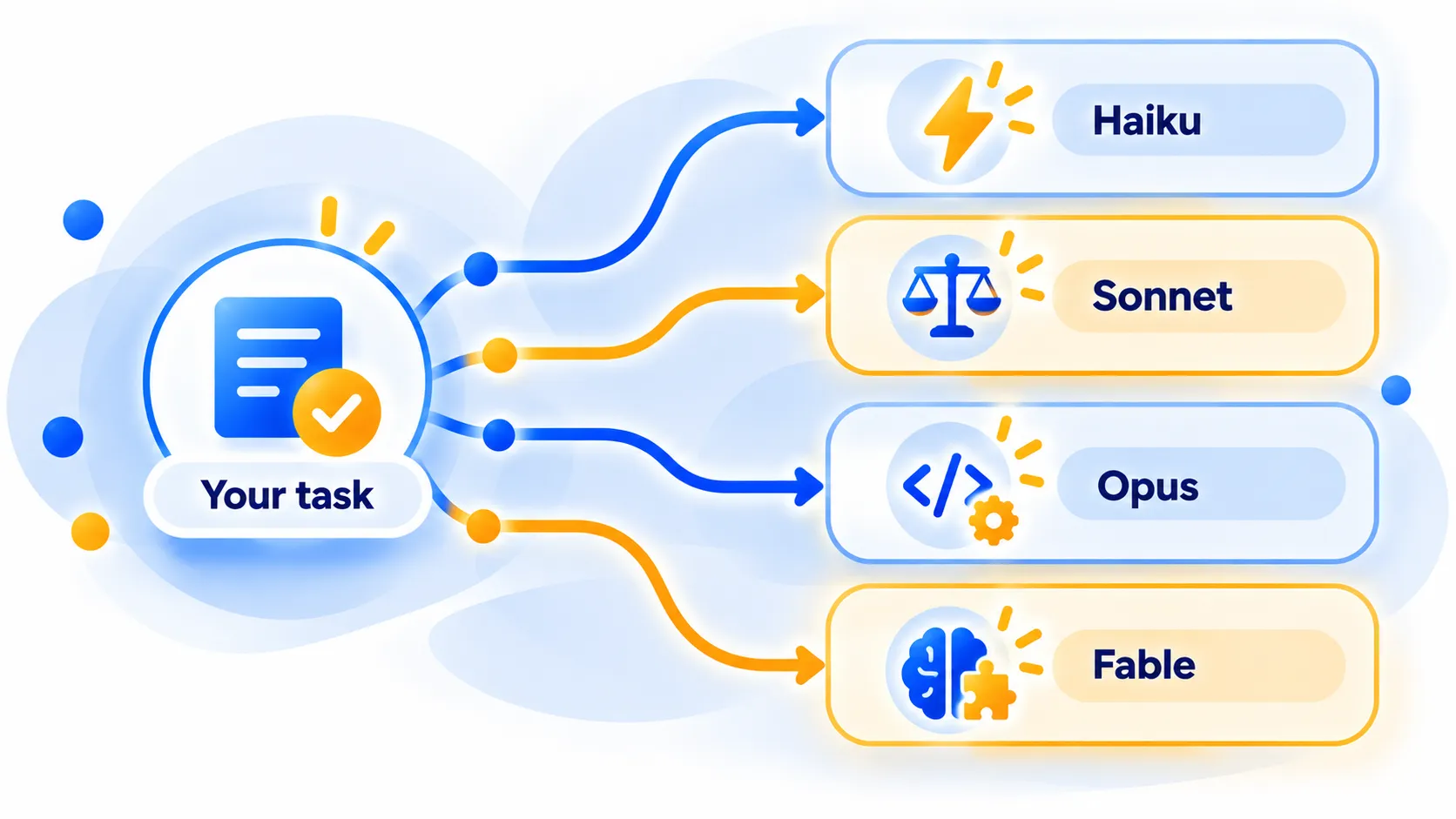
Think of the line-up as a ladder. Haiku is the quick, low-cost model at the bottom. Sonnet sits in the middle as the balanced all-rounder. Opus is the stronger model for long, complex jobs. Fable is at the top for the hardest reasoning and agent-style work, and it is the slowest and most expensive.
Anthropic’s own model guidance says to start with Opus 5.5 for most workloads (aimed at developers choosing an API model), and to move to Fable 5.1 when you need demanding reasoning or when Opus at higher effort still falls short in your tests. For everyday chat use, the choice is usually between Sonnet and Opus, because those two cover most needs.
Note: These details come from the company’s own announcements and have not been independently verified by Next DigiTech.
Claude Haiku 5.5: Fast and Cheap
Haiku 5.5 is built for speed and volume. Anthropic points to classification, data extraction and routing: the kind of repetitive jobs where thousands of requests need quick, low-cost answers. It is listed as the fastest model.
Use it for: sorting emails or tickets, pulling fields out of documents, quick summaries, simple rewrites and customer-support triage.
Watch out for: very hard reasoning or long multi-step projects, where a bigger model is likelier to hold up. Also note the price is shown as “from $0.10 / $0.50”, and Anthropic’s pricing page lists a higher rate ($0.50 input, $2.50 output) for prompts over 100K tokens. For a full walkthrough, see our Claude Haiku 5.5 guide.
Claude Sonnet 5.5: The All-Rounder
Sonnet 5.5 is described by Anthropic as the best combination of speed and intelligence. It is the model the free plan offers (alongside Haiku), so it is what many people use every day.
Use it for: drafting and editing, research summaries, spreadsheet help, everyday coding, brainstorming and analysis.
Watch out for: extremely long or tricky agent tasks, where Opus or Fable may be steadier. At $2 input and $10 output per million tokens, it costs half of Opus on the API.
Claude Opus 5.5: For Long, Serious Work
Opus 5.5 is positioned for long-running agentic coding and knowledge work, and Anthropic’s docs suggest it as the default starting point for most API workloads. It runs at moderate speed, and the docs list its default effort as medium with adaptive thinking always on.
Use it for: large coding tasks, reviewing long documents, complex analysis, multi-step research and projects where quality matters more than speed.
Watch out for: cost and speed. At $4 input and $20 output per million tokens, it is twice the price of Sonnet. On consumer plans it is available on Pro and Max, not on Free.
Claude Fable 5.1: The Heavy Hitter
Fable 5.1 is Anthropic’s top option for demanding reasoning and long-horizon agentic work, meaning tasks where the AI has to plan and act over a long stretch. It is listed as slower, with default effort set to high and adaptive thinking always on.
Use it for: the hardest problems, where Opus at higher effort still falls short in your own testing.
Watch out for: price and limits. API pricing is $10 input and $50 output per million tokens, which is 2.5 times Opus. On consumer plans, Anthropic’s pricing page says Pro users reach Fable through usage credits, while Max includes it at 50% of weekly limits. For most people, Fable is overkill.
Note: Features and policies may vary by plan, region and app version, and can change at any time. Check the official help center for the latest information.
Which Plan Gets Which Model?
| Plan | Models listed | Price listed |
|---|---|---|
| Free | Sonnet and Haiku | $0 |
| Pro | Opus, Sonnet, Haiku; Fable via usage credits | $20 per month billed monthly, or $17 per month billed annually ($200 up front) |
| Max | Opus, Sonnet, Haiku, plus Fable at 50% of weekly limits | From $100 per month (5x or 20x Pro usage) |
Anthropic’s page gives only the “from $100” starting price for Max, not a separate price for each tier, and exact usage limits are not published as hard numbers. Prices shown are in US dollars and may differ by country and tax.
Note: Prices are based on official announcements at the time of writing and may vary by country, retailer, taxes and promotions. Always check the latest pricing on the official website before buying.
What Do They Have in Common?
- Context: 1 million tokens listed for all four, so long documents are not just a top-tier feature.
- Output: up to 128K tokens listed for all four.
- Inputs: text and images, with text output, tool use and multilingual support.
- Knowledge cutoff: Anthropic lists a reliable knowledge cutoff of June 2026 for all four.
- Thinking: adaptive thinking on all, and always on for Opus and Fable.
Because the specs match so closely, the real differences are speed, depth on hard tasks and price.
How to Choose: A Simple Rule of Thumb
- Start with Sonnet for everyday work. It is fast and included on the free plan.
- Drop to Haiku when you need quick answers in bulk or want to save money.
- Step up to Opus for long coding sessions, big documents or work where mistakes are costly.
- Try Fable only when Opus is not enough after you have tested it on your actual task.
A practical tip: run the same prompt on two models and compare. If the cheaper model gives an answer you are happy with, there is no reason to pay for more.
Frequently Asked Questions
Which Claude model is best for everyday use?
For most people, Sonnet 5.5. Anthropic describes it as the best combination of speed and intelligence, and it is available on the free plan.
Is Opus 5.5 better than Sonnet 5.5?
Opus is positioned for long-running agentic coding and knowledge work, so it is the stronger choice for big, complex jobs. It is also slower and costs twice as much on the API. For simple tasks the difference may not be noticeable.
What is Claude Fable 5.1?
It is Anthropic’s model for demanding reasoning and long-horizon agentic work. It is slower and the most expensive of the four, at $10 input and $50 output per million tokens on the API.
Can I use Fable on the free plan?
No. Anthropic’s pricing page lists Sonnet and Haiku on the free plan. Pro reaches Fable through usage credits, and Max includes it at 50% of weekly limits.
Do all Claude models have the same context window?
According to Anthropic’s model overview, all four list a 1 million token context window and up to 128K tokens of output. Check the docs, as limits can change.
The Bottom Line
Claude’s four models differ mainly in speed, depth and price rather than in basic features. Use Haiku for quick, high-volume jobs, Sonnet for everyday work, Opus for long and serious projects, and Fable only when you truly need the most demanding reasoning. If you are unsure, start with Sonnet and move up only when the results fall short. Always confirm current plans and prices on Anthropic’s official pages, since both can change.
Related Guides
- Claude Haiku 5.5 Explained: The Fast, Cheap Claude Model for Everyday Tasks
- ChatGPT vs Gemini vs Claude: Which AI Assistant Fits You? (2026)
- What Is Claude Code? A Simple Guide for Non-Developers (2026)
- Claude Projects and Artifacts: How to Use Them (Step by Step)
Explore more in our AI Tools hub.
Disclaimer: This article is for general information only and is based on details available at the time of writing. Prices, plans, features, release dates, policies and availability can change at any time and may vary by country. Please verify the latest information on the official website of the company or product mentioned before making any decision or purchase. Next DigiTech is an independent website and is not affiliated with or endorsed by the companies mentioned; all trademarks belong to their respective owners. We are not responsible for any loss or decisions made based on this content.