

Consensus is an AI search engine for scientific research. Instead of searching the whole web, it searches over 200 million peer-reviewed research papers and gives you answers backed by real studies, with citations. Its Consensus Meter even shows how much the research agrees on a yes-or-no question.
Here’s what Consensus does, what’s free, and how its pricing changed in 2026.
Quick Verdict
- Best for: Students, researchers, health and science writers, and anyone who wants evidence-based answers.
- Not ideal if: You need general web answers or news. Try Perplexity for that.
- Is the free plan enough? For occasional questions, yes. Regular researchers will want Pro.
What Is Consensus?
Consensus is an AI-powered academic search engine at consensus.app. You ask a research question in plain English, like “Does intermittent fasting help with weight loss?”, and it finds relevant studies, summarizes what they found and links to each paper.
Key Features
- Search 200M+ papers with plain-language questions.
- Consensus Meter: Shows whether studies mostly say yes, no or possibly.
- Pro analysis: AI summaries of the top papers with citations.
- Deep reviews: Longer, literature-review style reports across many papers.
- Study Snapshots: Quick facts about a paper, like sample size and methods.
- Filters: Study type, year, journal quality and more.
- Library and export: Save papers and export citations.
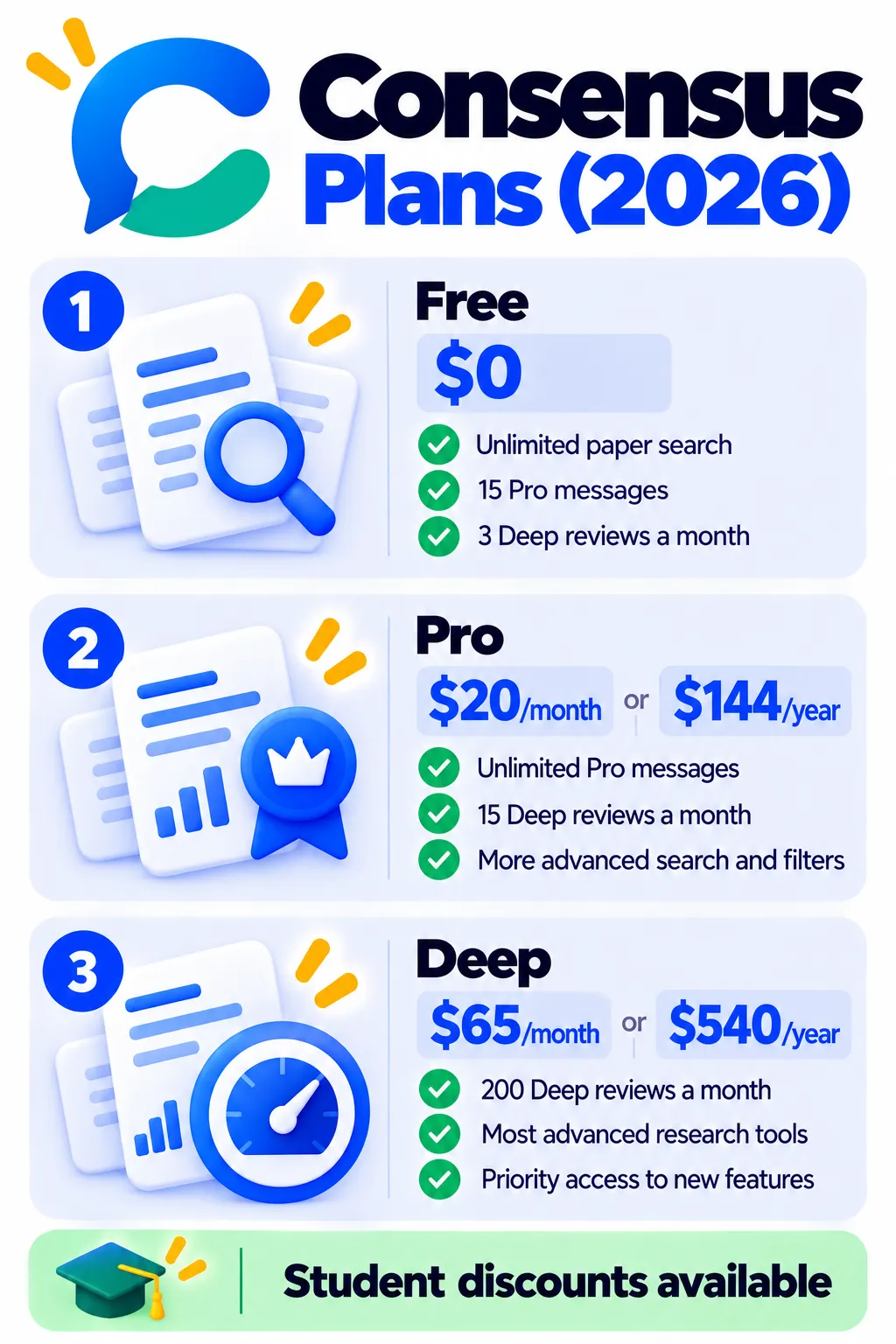
Consensus Pricing (2026)
Consensus raised its Pro price in 2026. Prices as of October 2026:
| Plan | Monthly | Yearly | What you get |
|---|---|---|---|
| Free | $0 | $0 | Unlimited paper search, 15 Pro messages, 3 Deep reviews and 10 Study Snapshots a month |
| Pro | $20 | $144 (about $12/month) | Unlimited Pro messages, 15 Deep reviews a month, unlimited Study Snapshots |
| Deep | $65 | $540 (about $45/month) | Everything in Pro plus 200 Deep reviews a month |
| Teams | Custom | Custom | For labs and organizations |
Students and faculty can often get a discount. Check consensus.app/pricing for current offers.
How to Use Consensus (Step by Step)
- Go to consensus.app and sign up free.
- Ask a clear research question, ideally one that can be answered yes or no.
- Look at the Consensus Meter and the summary.
- Open the top papers and check the study type, sample size and date.
- Use filters to focus on stronger evidence, like randomized controlled trials or meta-analyses.
- Save useful papers and export citations for your work.
Good Questions to Try
- “Does mindfulness meditation reduce anxiety?”
- “Is remote work linked to higher productivity?”
- “Does screen time before bed affect sleep quality in teenagers?”
- “What are the effects of creatine on memory?”
Pros and Cons
Pros
- Answers based on peer-reviewed research
- Consensus Meter gives a quick overview
- Useful free plan with unlimited paper search
- Helpful filters for evidence quality
Cons
- Pro price increased in 2026
- AI summaries can oversimplify complex research
- Not for news or general web questions
- Free plan limits Deep reviews
Important: Use Research Responsibly
Consensus is a starting point, not a final answer. Always read the key papers, check the study quality, and don’t use AI summaries alone for medical, legal or financial decisions. For school work, follow your instructor’s rules on AI tools.
Consensus vs Elicit vs Perplexity
- Consensus: Fast evidence-based answers with an agreement meter.
- Elicit: Better for detailed literature reviews and extracting data from many papers.
- Perplexity: Better for general web research with sources.
See our full guide to the best AI tools for research.
Frequently Asked Questions
Is Consensus AI free?
Yes. The free plan includes unlimited paper search plus a monthly allowance of Pro messages and Deep reviews.
How much is Consensus Pro?
Pro is $20 a month or $144 a year (about $12 a month) as of late 2026.
What is the Consensus Meter?
It shows how many relevant studies say yes, no or possibly to your question.
Is Consensus accurate?
It’s based on real papers, but AI summaries can miss nuance. Always read the most important studies yourself.
Can I use Consensus for my thesis?
It’s great for finding papers, but cite the original studies, not the AI summary.
The Bottom Line
Consensus is one of the best free ways to find what science actually says about a question. Start free, use filters for stronger evidence, and upgrade to Pro if you research regularly. Explore more tools in our AI tools directory.
Related Guides
- What Is NotebookLM? How to Use Google’s Free AI Notebook (2026)
- How to Use ChatGPT for Studying: 10 Smart Prompts (Without Cheating)
- How to Use AI to Summarize Long Documents (Without Missing Key Details)
- Quizlet Review 2026: Is Quizlet Plus Worth It? Free vs Paid Explained
Explore more in our AI Tools for Students and Teachers hub.
Disclaimer: This article is for general information only and is based on details available at the time of writing. Prices, plans, features, release dates, policies and availability can change at any time and may vary by country. Please verify the latest information on the official website of the company or product mentioned before making any decision or purchase. This is not medical, financial, legal or security advice; consult a qualified professional for your situation. Next DigiTech is an independent website and is not affiliated with or endorsed by the companies mentioned; all trademarks belong to their respective owners. We are not responsible for any loss or decisions made based on this content.