AI-generated images are now so realistic that fake photos of celebrities, disasters and “breaking news” spread online every day. Some are harmless fun, but others are used for scams and misinformation. The good news: with a few simple checks, you can spot many fakes before you share them.
Here’s how to tell if an image is AI-generated in 2026.
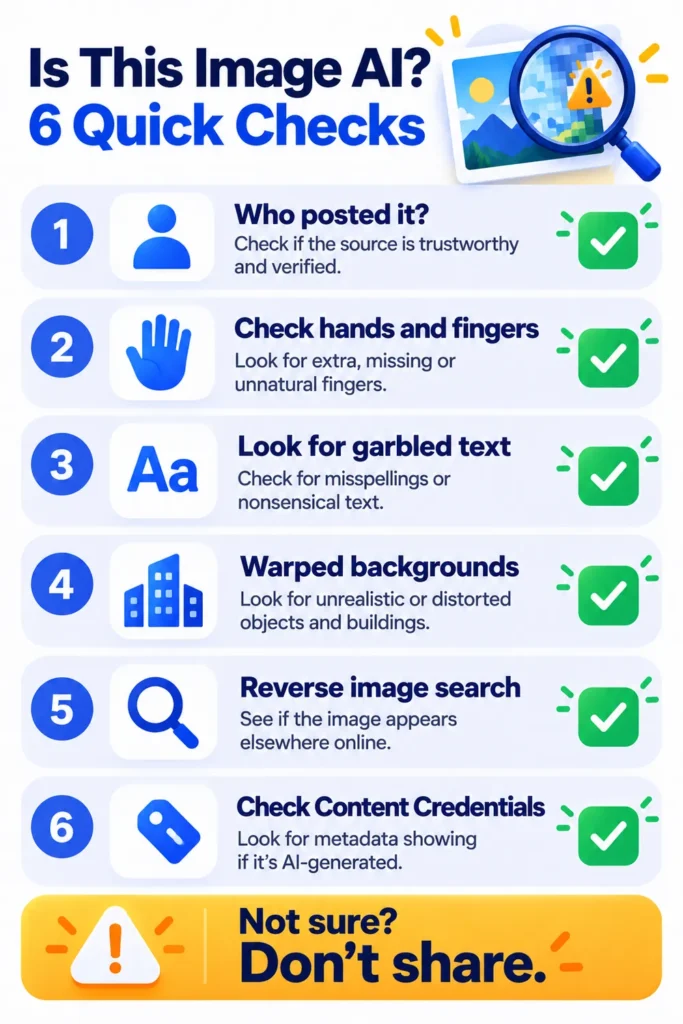
Step 1: Check the Source First
- Who posted it? A trusted news outlet or an anonymous account?
- Is it reported elsewhere? Big real events are covered by several reliable sources.
- Does it feel designed to make you angry or shocked? That’s a common sign of misinformation.
Step 2: Look for Visual Clues
AI has improved, so these clues aren’t always present, but they’re still worth checking:
- Hands and fingers: Extra, missing or oddly bent fingers.
- Text: Signs, labels or posters with garbled or nonsense letters.
- Eyes, teeth and ears: Mismatched earrings, uneven pupils or blurred teeth.
- Backgrounds: Warped buildings, melting objects or people who blend together.
- Lighting and shadows that don’t match the scene.
- Too-perfect skin with a plastic, airbrushed look.
Step 3: Use a Reverse Image Search
Upload the image to Google Lens or TinEye to see where else it appears. If the earliest version comes from an AI art account or the image only exists on social media, be skeptical.
Step 4: Look for AI Labels and Content Credentials
- Content Credentials: Many AI tools, including Adobe Firefly, attach a digital label showing an image was made or edited with AI. You can check images at the Content Credentials verification website.
- Invisible watermarks: Google uses SynthID to mark images made with its AI tools, and some Google products can check for it.
- Platform labels: Social networks increasingly add “AI info” or “made with AI” labels.
Missing labels don’t prove an image is real, because labels can be removed by screenshots or edits.
Note: These details come from the company’s own announcements and have not been independently verified by Next DigiTech.
Step 5: Be Careful With AI Detector Tools
Online AI image detectors can help, but they make mistakes in both directions. Treat their results as one clue, not proof. The same is true for text detectors, as explained in do AI detectors actually work?
Common AI Image Scams
- Fake celebrity endorsements for crypto or diet products.
- Fake disaster photos used to collect donations.
- Fake product photos in online shops.
- Fake profile photos in romance and job scams.
AI voices are also used in scams. Learn how to protect your family in AI voice cloning scams.
Frequently Asked Questions
Can you always tell if an image is AI?
No. The best AI images can fool experts. Combine source checks, visual clues and reverse image search.
Are AI image detectors accurate?
They can help but aren’t reliable enough to be proof on their own.
What are Content Credentials?
A digital label that records how an image was created or edited, including whether AI was used.
What should I do if I’m not sure?
Don’t share it. Look for coverage from trusted news sources first.
The Bottom Line
Start with the source, look for visual clues, run a reverse image search and check for AI labels. When in doubt, don’t share. Learn more about AI image tools in our best free AI image generators guide.
Related Guides
- What Is Adobe Firefly? Features, Pricing and Commercial Use (2026)
- Is It Safe to Share Personal Info With AI Chatbots?
- Is My Phone Hacked? 10 Warning Signs and What to Do Next
- How to Spot a Fake App Before You Download It (7 Warning Signs)
Explore more in our Online Safety and Privacy hub.
Disclaimer: This article is for general information only and is based on details available at the time of writing. Prices, plans, features, release dates, policies and availability can change at any time and may vary by country. Please verify the latest information on the official website of the company or product mentioned before making any decision or purchase. This is not medical, financial, legal or security advice; consult a qualified professional for your situation. Next DigiTech is an independent website and is not affiliated with or endorsed by the companies mentioned; all trademarks belong to their respective owners. We are not responsible for any loss or decisions made based on this content.